

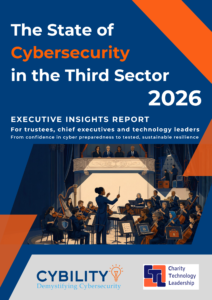
State of Cybersecurity in the Third Sector 2026

Cybersecurity confidence is high
Tested organisational resilience is less certain
Cybility logo with the word “CYBILITY” in bold dark blue uppercase letters and the tagline “Demystifying Cybersecurity” in light blue beneath it, followed by an orange outline of a lit lightbulb with rays, symbolising clear, approachable cybersecurity guidance.
in partnership with
CTL new logo and name

This report brings together survey evidence and interviews with third-sector technology leaders to examine preparedness, people, governance, resources, suppliers and AI. It turns the findings into practical questions for trustees, executives and the people responsible for making resilience work. 

Cybersecurity report for third sector cover

Table of Contents

The central finding

Controls are only part of resilience 

The organisations represented in this research have invested in controls, policies, training and recognised frameworks. The harder question is whether people, decisions, suppliers and recovery arrangements will work together under pressure. 

Across the interviews, technology leaders described incomplete or untested recovery activity, responsibility returning to technology teams, limited capacity to assure growing complexity and AI exposing older information-governance weaknesses. 

The next step is not simply to add more controls. It is to build the organisational capacity to make existing controls, people and processes work together when it matters.

Cyber resilience is not demonstrated by how many instruments are in the orchestra. It is demonstrated by whether the organisation has rehearsed what happens when the music stops.

The evidence behind the report

39 unweighted survey responses

4 anonymised in-depth interviews 

27 respondents reporting annual revenue above £10 million 

27 respondents identifying as IT, digital or technology leads 

The survey was promoted across the UK’s third sector and civil society through infrastructure bodies, membership organisations, direct email, LinkedIn and our own networks. In total, 70 people responded, with 39 completing the survey in full.

Although we sought views from across leadership and organisational roles, respondents were predominantly technology leaders. The findings therefore reflect this respondent group’s experiences and perceptions, rather than estimates for the sector as a whole. 

The findings presented here are based on the 39 completed responses, with the number answering each question shown alongside the results.

Key Findings

Finding one: Preparedness

Confidence needs evidence behind it 

Thirty-six of 39 respondents felt fairly or very confident that their organisation could respond effectively to a cybersecurity incident. The same total expressed confidence in recovery and continuing their work. Yet only 14 reported a documented incident response plan fully in place, 11 reported regular backup-restoration testing fully in place and nine reported a business continuity plan covering cybersecurity incidents fully in place. Confidence and implementation are different measures. These results do not prove overconfidence, but they do support a sharper leadership conversation about what has been completed, tested and learned.

Board Question

What have we rehearsed or restored, what happened, and what remains incomplete?

Practical Action

Ask for evidence from a response rehearsal or restoration test, then assign an owner and date to the most important unresolved dependency.

Scope Note

These measures are self-reported and do not test how an organisation would perform during a real incident.

Finding two: People and sustainability 

The human factor includes the people carrying the responsibility 

Twenty-two of 39 respondents described their cybersecurity and data-protection workload as frequently overwhelming or often more than they could comfortably manage. Eighteen reported some or significant negative effect on their wellbeing. Nineteen said the responsibility was manageable for now but not for the long term, while five said something would have to change. The result is not a diagnosis of burnout. It is evidence that organisational capacity and personal sustainability are not the same question. A programme can look manageable at organisational level while depending on people who cannot safely maintain the tempo. 

Leadership Question

What would continuing at this level mean for the next 12 months?

Practical Action

Review cover, competing demands and work that should stop, be shared or receive specialist support. Do not respond by adding another task to the same person’s list.

Scope Note

The survey used self-reported workload and wellbeing measures, not clinical measures.

Finding three: Leadership and governance 

Board updates and documented strategy are different things 

Twenty-one of 39 respondents reported quarterly board updates, with six reporting monthly updates or updates at every board meeting. Nineteen reported a formal, documented cybersecurity and data-protection strategy; 19 reported no such strategy. Twelve were not confident that their board understood the risks facing the organisation. Receiving information, setting direction, understanding risk and following through are distinct governance milestones. Reporting matters when it helps the board make, resource and revisit a decision.

Board Question

What decision does this update require, who owns it, and when will we review progress?

Practical Action

Connect board reporting to an agreed strategy. Record decisions, resources, ownership and follow-up rather than recording only that a presentation took place.

Scope Note

Board understanding was assessed by respondents; trustees were not directly tested.

Finding four: Funding and capacity 

Having a budget does not mean having enough capacity 

Thirty-four of 39 respondents reported cybersecurity funding through a dedicated line or a wider IT or risk budget. Among those 34, only two described organisational capacity as adequate; 24 described it as stretched but manageable, five as significantly under-resourced and three as very limited. The relevant question is not simply whether money exists. Leaders need to understand what the funding, staff time, skills, tools and external support can realistically deliver.

Executive Question

Can we deliver the work we have agreed, at the standard and pace we expect?

Practical Action

Review capacity against the organisation’s agreed priorities and change portfolio. Treat simplification and standardisation as possible security strategies, not merely efficiency exercises.

Scope Note

The evidence does not compare spending levels or show that a dedicated budget line causes better outcomes.

Finding five: AI governance 

AI policy approval is not the same as operational control 

Twenty-eight of 39 respondents said their organisation recognised some risks from AI tools but had limited controls in place. Nineteen reported a formal AI policy approved by the board; 12 of those 19 still selected the limited-controls response. A policy is an important governance milestone, but it is not the finish line. The practical test is whether people understand permitted uses, information-handling rules, accountability and how to raise an exception. The interviews also linked AI readiness to information governance. Participants described fragmented information, inconsistent retention, unclear ownership and limited visibility over what the organisation still held. AI did not create those weaknesses, but it could make their consequences easier to expose.

Board Question

Do we understand the information our AI systems will be allowed to find, combine and present?

Practical Action

Translate policy into usable rules covering approved tools, organisational information, permissions, retention, ownership, human review and exceptions.

Scope Note

The study did not independently assess policy quality or control effectiveness.

Finding six: Suppliers and dependencies 

Supplier reliance is substantial; confidence needs a basis 

Thirty of 39 respondents described their organisation as quite or very reliant on suppliers or outsourced services for critical systems and data. Twenty-seven were fairly confident in key suppliers’ security practices, while confidence among the most reliant respondents remained mostly qualified rather than absolute. Interview participants described using certifications, procurement checks, restricted privileges and contractual requirements. They also raised uncertainty about compromised supplier accounts, configuration, downstream providers and whether contracted controls would produce the expected operational outcome.

Leadership Question

Which suppliers could interrupt the mission, and what evidence supports our confidence in them?

Practical Action

Prioritise supplier assurance by critical-service dependency and data exposure. Clarify internal ownership and contingency arrangements as well as contractual expectations.

Scope Note

The survey did not independently assess supplier security, contracts or the assurance activities supporting respondents’ confidence.

What technology leaders told us

The interviews explain how resilience feels in practice 

Four anonymised interviews add operational depth to the survey. They do not establish how common an experience is across the sector. They show how technology leaders make sense of controls, ownership, capacity, supplier risk, reporting culture, training, certification and AI inside their organisations.

“Getting to test the plan is like major surgery.”
Senior technology leader at a large UK charity

The strongest cross-interview themes were: 

  • Control adoption is ahead of tested organisational resilience. 
  • Cybersecurity is described as everyone’s responsibility, but practical ownership often returns to technology. 
  • Assurance capacity is constrained by technology, supplier and change complexity. 
  • People who report quickly are part of detection and containment, not “the weakest link”. 
  • Training completion is not the same as engagement or behaviour change. 
  • Cyber Essentials can provide a useful foundation, but certification does not remove the need to test recovery and improve governance. 
  • AI is changing both opportunity and risk while amplifying older information-governance weaknesses.

The difficulty is not a lack of awareness alone. It is turning shared responsibility into explicit, rehearsed action across leadership, operations, communications, finance, HR, safeguarding and technology. 

From evidence to action 

A practical agenda for the next board cycle 

The report’s recommendations can be organised using CyberDeck8D™’s three modes: Prepare, Participate and Probe. This keeps the work connected before, during and after decisions rather than treating cybersecurity as an annual update. 

Prepare

Participate

Probe

  • Connect technical recovery to mission continuity: Identify the services, information, people and suppliers the organisation must protect or restore first. 
  • Make critical dependencies visible: Name internal owners, supplier dependencies, offline communication routes and decisions that may be needed during disruption. 
  • Turn AI policy into everyday guidance: Make approved uses, information handling, responsibilities and exceptions clear enough to use under normal working pressure.
  • Make board reporting lead to decisions: Connect information to priorities, ownership, resources and follow-through. 
  • Treat sustainable responsibility as a leadership issue: Review workload, cover, competing demands and access to specialist support. 
  • Share incident roles beyond technology: Give executives, service owners and corporate functions explicit responsibilities and opportunities to practise them. 
  • Test the arrangements behind confidence: Exercise decisions and services, not only technical restoration. 
  • Review the evidence supporting supplier trust: Prioritise the providers whose failure could interrupt essential work. 
  • Learn without blame: Use rapid reporting, containment and review to strengthen the system rather than shame an individual. 

The aim is not another layer of paperwork. It is to make sure the people, controls and decisions already in the score can perform together when it matters. 

Read, use and share the research 

Choose the format that works for you. The main findings and methodology remain available on the website; downloads provide the full detail and reusable supporting material. 

State of Cybersecurity in the Third Sector 2026

The complete report, including quantitative findings, interview insight, practical interpretation, limitations and recommendations.

Methodology and limitations

How the survey and interviews were analysed, who took part, how anonymity was protected and what the evidence can and cannot support.

Media pack

Approved summary copy, charts, report cover, partner information, citation details and spokesperson contacts.


Frequently Asked Questions (FAQ)

What does the report cover? 

It examines how respondents described cybersecurity incidents, preparedness, workload, governance, funding and capacity, supplier reliance, emerging threats and AI. Interviews add operational experience about testing, ownership, assurance, reporting culture and information governance.

Who took part?

The quantitative analysis uses 39 unweighted survey responses. The qualitative synthesis uses four anonymised interviews with technology-related leaders from medium and large charities.

Is the research representative of the whole third sector? 

No. It is a focused, technology-leader-weighted respondent group. The findings provide useful signals and practical insight, but they should not be quoted as sector-wide prevalence estimates.

Why show counts as well as percentages?

Counts keep the evidence base visible. With a sample of 39, “22 of 39 respondents” gives readers more context than a percentage on its own.

Is the report free?

Yes. The report, executive findings and methodology are free to read and download. Email sign-up is optional.

Can the charts be reused? 

Approved charts are available in the media pack. Reuse must preserve the title, source, base, categories, exclusions and evidence note. 

How was interview anonymity protected? 

 Names, employers, precise locations, exact workforce or income figures, named suppliers, distinctive mission details and identifying combinations were removed or generalised. Direct quotations are used only where the wording could be verified and publication use passed the disclosure review.

How should the report be cited?

Cybility and Charity IT Leaders (2026), State of Cybersecurity in the Third Sector 2026: Launch Edition, published 12 November 2026.

Can Cybility brief our board or leadership team?

Yes. We offer tailored, paid briefings to help boards and leadership teams explore what the report’s findings mean for their organisation’s preparedness, governance and resilience. Book a complimentary introductory call to discuss your priorities. We’ll agree the scope and fee with you before you commit.